“Has an MCP server” is the wrong question

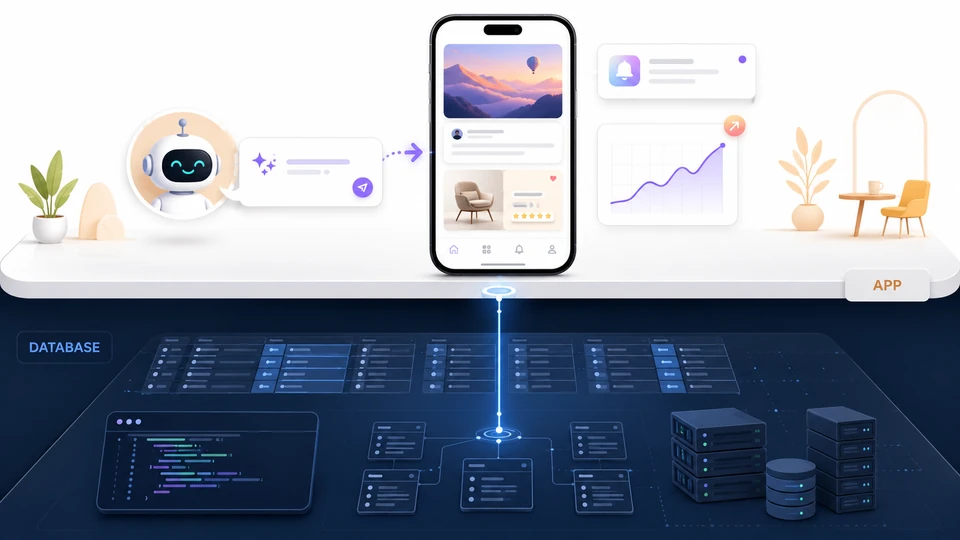
The short version. An MCP server is only as useful as what it exposes. BaaS platforms such as Back4app and Supabase expose their backend: database tables, schemas, queries, cloud code. GoodBarber's MCP server exposes the operations of a live mobile app: publish an article, schedule a push, update the catalog, read the stats. 150 domain-typed tools at the time of writing, feature-gated, scoped to one app by OAuth, with a verified read-back on every write. Same protocol, very different altitude.
The Model Context Protocol has won fast. Introduced by Anthropic in November 2024 and donated to the Linux Foundation a year later, MCP is now the standard way to hand tools to an AI agent, with more than 9,400 public servers listed in the official MCP Registry in 2026. Which means the phrase “we have an MCP server” has quietly become a checkbox. Every platform can tick it, and the tick tells you nothing.
The questions that matter sit one level deeper. What does the server let an agent see? What does it let an agent change? And when the agent writes, what stands between a well-phrased prompt and a broken production system? The answers depend far less on the protocol, which is the same for everyone, than on the altitude at which a platform plugs into it.
Two altitudes: MCP for your database, MCP for your app
Backend-as-a-Service platforms plug MCP into their infrastructure layer. Back4app's MCP server, as its documentation describes it in July 2026, lets an agent create and manage Parse apps, define database schemas, query and modify objects through the Parse REST API, manage users and permissions, and deploy cloud code. Supabase's official MCP server points the same way: list tables, execute SQL, run migrations, manage branches and Edge Functions. These are real, useful capabilities. They are also unmistakably backend-shaped: what the agent reads and writes are rows, schemas and deployments. Call it MCP for your database.
GoodBarber plugs MCP in at a different altitude: the application itself. GoodBarber's MCP server exposes the operations of a finished, published mobile app: publish an article, schedule a push notification, create a product with its variants, update an order, read the analytics. The agent never sees a table. It sees the same product-level actions the app's owner sees in the back office. Call it MCP for your app.
A BaaS MCP hands an agent the keys to your data. An application MCP lets an agent run your product, safely.
Side by side:
| BaaS MCP server | Application MCP server | |
|---|---|---|
| What the agent sees | Tables, schemas, rows, cloud functions | Articles, push campaigns, products, orders, stats |
| A typical tool | Run a SQL query, create a database class | cms_create_article, classic_create_push_broadcast |
| A write is | A raw data mutation | A product action, run through the application layer |
| Guardrails | Read-only modes, project scoping | Feature gating, per-app OAuth, verified read-back on every write |
| What you still build | The entire app around the backend | Nothing: the native app, hosting and store pipeline already exist |
| Built for | Developers in AI coding tools | Any operator, technical or not, in any MCP client |
| Examples | Back4app, Supabase | GoodBarber |
Why the altitude changes everything
Same protocol, same JSON, same agents on the other end. Four things change completely.
Semantics: the agent knows what it is doing
A backend tool speaks data. An application tool speaks intent. When an agent's tool is a raw SQL query, the agent knows it is inserting a row; whether that row makes sense as a product, a subscriber or a campaign is entirely the prompt's problem. When an agent calls classic_create_push_broadcast on GoodBarber's server, the tool's name, its typed schema and its constraints already encode what a push campaign is. There is far less room to be confidently wrong, because the domain knowledge lives in the tool, not in the prompt.
Safety: where the guardrails live
Good BaaS MCP servers do ship controls, and they matter: Supabase, for instance, offers a read-only mode and project scoping. But at database altitude, a permitted write is still a raw mutation. Nothing checks that the new row respects the invariants your application enforces everywhere else.
GoodBarber's MCP server enforces its guardrails at the product level, on the server side. Feature gating: a tool only exists if the matching feature is active in the app, so an app without push configured exposes no push tools at all. Per-app OAuth scope: every session is bound to one authenticated app, an agent connected to app A cannot see or touch app B, and agencies connect each client app separately. Verified writes: every write returns a server-side flag requiring the agent to read the object back and confirm the result before moving on. Hallucinated success is the failure mode agents are most prone to; GoodBarber's answer is to make verification part of the server's contract rather than a best practice left to the prompt.
Completeness: a database is not a product
An agent with full control of your backend still controls no product. The mobile app around that backend remains yours to design, build, connect, submit to the App Store and Google Play, and maintain: exactly the gap we mapped in AI app builders can build an app. Can they run one? An application MCP starts on the other side of that gap. The app already exists: compiled native iOS and Android builds plus a PWA, with hosting, CMS, push infrastructure and payments included rather than assembled from separate subscriptions. The agent operates a live product from day one, and there is nothing left to build around it.
Operators: who can actually use it
Back4app's MCP documentation lists the clients it is built for: Cursor, Windsurf, VS Code, Claude Code. Developer tools, reasonably, because driving a backend safely requires a developer's judgment. An application MCP moves the interface up to plain language. A shop owner can ask Claude to reprice a product, a publisher can ask ChatGPT to publish the morning's article and schedule the push, a club manager can ask for last month's downloads, and none of them needs an IDE. GoodBarber built its MCP surface for that operator, the same person its no-code back office was built for, and it works from any MCP client, including automation platforms like Zapier.
What GoodBarber's MCP server exposes
GoodBarber runs a hosted, production MCP server: nothing to install, nothing to self-host. You plug the endpoint into your MCP client, sign in with OAuth 2, and the session is scoped to your app from the first call.
The inventory is public and machine-readable. The server card lists 150 domain-typed tools at the time of writing (July 2026), namespaced by what they operate: tools prefixed cms_ cover content (articles, events, maps, photos, videos, podcasts, including scheduled publication), shop_ tools cover commerce (products and variants, collections, orders, promo codes, customers), and classic_ tools cover the running of the app (push broadcasts, analytics, memberships). The card is the contract: when the platform grows, the card grows, and connected agents pick up the new tools automatically. On top of the server, GoodBarber publishes 44 open-source Claude Skills that wrap common workflows as tested recipes, part of the same agent-ready platform push.
Just as deliberate is what the server does not expose. Design and layout stay in the builder, where GoodBarber's design system can protect them; pushing visual design through text-shaped tools does not produce good apps. And agent ready does not mean the human left the room: you grant the scope, you set the policies, and the server verifies what the agent does. Details and per-client setup live on the MCP page.
When a BaaS MCP server is the right choice
If you are a developer building custom software, with your own data model, your own business logic and your own frontend, a BaaS MCP server is exactly the right tool, and the good ones are genuinely good. Back4app's gives your coding agent a real Parse backend to build against; Supabase's does the same for Postgres, with scoping controls that show the category maturing. GoodBarber is not that tool and does not try to be: it will not host your custom backend, and it is built for content apps and mobile commerce, not for arbitrary software.
These are two altitudes for two different jobs, not two competitors on one axis. The practical test: if your project needs an agent that can touch raw data structures, you want a BaaS MCP. If it needs an agent that can run a live mobile app, you want an application MCP.
Which MCP server does your project need?
- You are building custom software and want an agent working on your schema, data and cloud code: choose a BaaS MCP server such as Back4app or Supabase.
- You want an agent to operate a real mobile app in production, across content, catalog, push notifications, orders and analytics: choose an application MCP server. That is what GoodBarber runs.
- The app's day-to-day operator does not code: an application MCP is the only altitude that works in plain language from mainstream clients like Claude and ChatGPT.
- You need both: some teams run them side by side, a BaaS MCP for the custom system a developer maintains, GoodBarber's MCP server for the mobile app the business operates. The protocol is the same; only the altitude differs.
FAQ
What is the difference between a BaaS MCP server and an application MCP server?
A BaaS MCP server exposes backend infrastructure to an agent: database tables, schemas, queries, cloud functions. An application MCP server exposes the operations of a finished product. GoodBarber's MCP server lets an agent publish content, schedule push notifications, manage a catalog and read analytics on a live mobile app, without ever touching raw data structures.
Does GoodBarber's MCP server give an agent access to my database?
No. GoodBarber's MCP server exposes product operations, not SQL. An agent works with articles, products, orders, push campaigns and stats through domain-typed tools, and every call runs through the same application layer as the back office, so business rules and validations apply. Raw table access is never on the menu.
Is an MCP server on a backend enough to run a mobile app?
No. A backend MCP server operates the data layer, and the app around it still has to be designed, built, connected, submitted to the App Store and Google Play, and maintained. An application MCP server operates an app that already exists. That is the difference between managing rows and running a product.
How does GoodBarber keep agent writes safe?
Through three server-enforced layers. Feature gating: a tool only exists if the matching feature is active in the app. Per-app OAuth scope: an agent connected to one app cannot reach another. Verified writes: after every write, the server requires the agent to read the object back and confirm the result. Safety lives on the server, not in the prompt.
What is the best MCP server for a no-code mobile app?
Judge any candidate on three criteria: tools that speak the app's language rather than raw SQL, authentication scoped to a single app, and server-enforced verification on writes. GoodBarber's MCP server checks all three, with 150 domain-typed tools at the time of writing and a public server card listing every one of them, so you can verify the inventory instead of taking the claim on faith.
See the altitude difference for yourself. Start a free trial, build your app, then plug its MCP endpoint into Claude, ChatGPT or any MCP client: connecting an agent to a live app takes about two minutes. The complete MCP guide covers setup client by client.